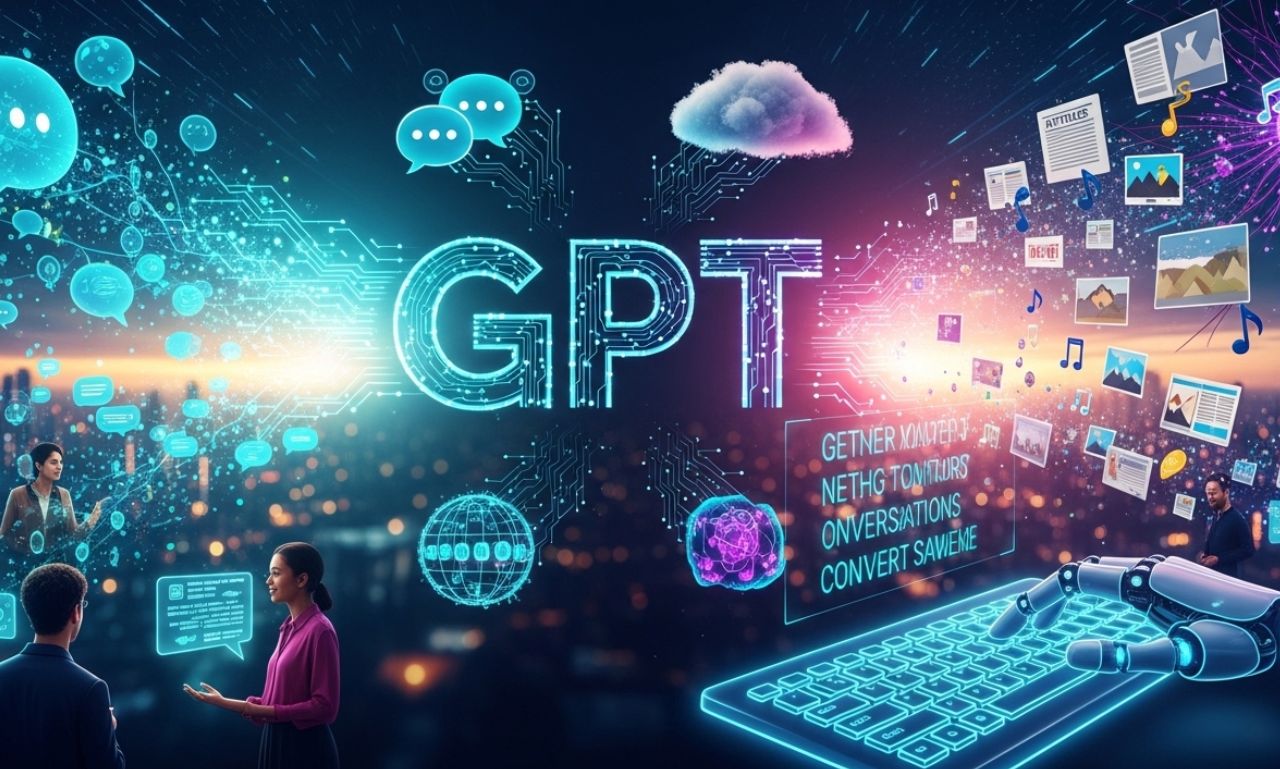
GPT, short for Generative Pre-trained Transformer, is an advanced artificial intelligence language model developed to understand and generate human-like text. From writing articles and coding to answering questions and holding conversations, GPT has transformed how individuals and businesses interact with technology. Its applications span across education, customer service, content creation, and more, making it a cornerstone of modern AI development.
What is GPT?
The Technology Behind GPT
GP T is based on deep learning and neural networks. It uses a transformer architecture that allows it to process and generate natural language with context awareness. By training on vast amounts of text data, GP T learns grammar, facts, reasoning abilities, and even some level of common sense.
Evolution of GPT Models
OpenAI has released several versions of GP T, each improving upon the last:
-
GP T-1: Introduced the concept of generative pre-trained transformers.
-
GP T-2: Offered significantly larger scale and more coherent text generation.
-
GP T-3: Became widely known for its human-like responses and multi-task abilities.
-
GPT-4 and beyond: Focus on more nuanced understanding, safety, and context retention.
Applications
Content Creation
Writers, marketers, and bloggers use GP T to draft articles, generate creative content, and even brainstorm ideas. It can assist in producing high-quality text quickly, saving time and enhancingproductivity.
Chatbots and Customer Service
GP T powers advanced chatbots capable of handling customer queries, providing product recommendations, and simulating human-like conversation. Companies integrate GP T to improve user experience and automate repetitive tasks.
Education and Learning
Students and educators benefit from G PT for tutoring, answering questions, and explaining complex topics. Its ability to adapt to different levels of understanding makes it a valuable educational tool.
Coding Assistance
GP T can generate code snippets, debug errors, and suggest programming solutions. Developers use it to speed up software development and improve learning efficiency.
Benefits of GPT
-
Human-Like Interaction: Produces natural, coherent responses.
-
Scalability: Can handle vast numbers of queries simultaneously.
-
Versatility: Useful in writing, research, coding, and conversation.
-
Time-Saving: Reduces manual effort in content creation and problem-solving.
Limitations of GPT
While GP T is powerful, it has limitations:
-
Factual Accuracy: GP T may produce incorrect or outdated information.
-
Context Understanding: It can struggle with highly nuanced conversations.
-
Ethical Concerns: Risk of generating biased, misleading, or harmful content.
-
Dependency: Over-reliance on GP T may reduce critical thinking or creativity in humans.
The Future of GPT
The future of GP T involves improving understanding, safety, and creativity. Upcoming models aim to provide better reasoning, integrate multi-modal inputs like images and audio, and work seamlessly with human collaborators. GP T is likely to become a standard tool in workplaces, classrooms, and personal productivity suites.
Conclusion
GP T represents a major leap in artificial intelligence and natural language processing. From transforming content creation to enabling intelligent conversation, GP T’s versatility makes it a pivotal technology in today’s digital world. While challenges remain, its potential to assist, innovate, and enhance human productivity is enormous. As AI evolves, GP T will continue shaping the way we communicate, learn, and work.